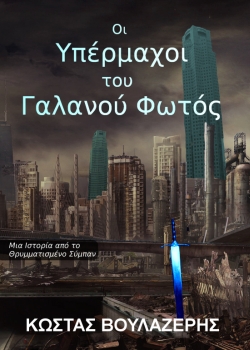
This is an interview that I gave to Cristian Tamas in December 2013. Cristian Tamas translated it in Romanian and posted it
here. Below you can read it in
English, as it was originally conducted.
1.Greek SF&F is a terra incognita not only in Romania but also in Europe and in the world. Why is it so ?
To be perfectly honest, I don’t know. Perhaps, there are no Greek SF stories that have gained positive attention from international critics. Or there is no one interested in promoting Greek stories to international audience.
2. What is the status in Greece of the greek SF&F writer and of the greek editor and scholar interested by the local domain of the imaginary ? Are there in Greece, literary critics and theoreticians focused on SF&F, or only reviewers ? Do you have a literary canon in Greece ? Who is establishing the literary canon ? The Greek Academy or some influent literary critic/s ? What about greek fanastic literature (fantastika), it exists ?
Wow! Many question in one...
Firstly, I don’t think there is any literary canon, and I don’t think that’s bad. If it existed, I would probably be outside the canon. I hate canons and cannons.
I think there are few people in Greece interested in SF as genre, and as for status, you have to define what you mean by "status" first. If you mean how seriously they are taken, it really depends on who is judging. Mainstream people wouldn’t give much notice. And the few people who are interested in it, well, they are interested in it.
There are, indeed, some people who review recently published books, for example Mr. Makis Panorios. Personally, I write about SF books but not necessarily recently published or Greek; usually what I happen to read at the time, and not all of them. I am interested very much in litterary theory, not specifically for the SF genre but broadly, the way you can tell a story – characters, plot structure, different and weird styles of writing, etc – and then I am interesting in how all these can be applied to stories happening in an imaginary world (meaning not our own Earth and having from slight to big differences in the internal and external workings of the world). I have written articles about all that in my website, and still keep writing. It’s a theme with many angles. Anyway, I wouldn’t want to bore your readers with a longer answer.
So. Does fantastika exist in Greece? Well, I write it, so I guess it does. Universe Pathways also publishes Greek SF books, as well as Triton. And many small publishers of Greek SF have appeared, and disappeared, at times. Also, there are Greek SF books being published by various publishers not known for publishing SF. So, yes, it is kind of confusing to keep track of. But surely fantastika exists in Greece.
3. What is the status, if any, of the greek Science Fiction & Fantasy within the greek culture ? Is it considered just genre junk as in the rest of the european continental countries ?
Well, I don’t think that in Greek culture SF is "considered" at all, except for those who are interested in it specifically.
The weird thing is that most people watch movies that are science fictional or fantasy – big, block-buster movies like the Hobbit or Avatar – but they won’t consider reading an SF or fantasy novel...
4. How you characterize the greek science fiction ? What’s its unique voice ?
If there is an answer I could give here, it would be more or less what I said in
the SFSignal Mind Meld some years ago. But I’d hate to give a single general characterization for the whole Greek SF scene. I haven’t read everything, for one. And even if I had I would still not be able to give a single characterization. It wouldn’t be fair, in my opinion.
5. Who are the main greek SF&F writers and which are their relevant works (novels and short stories)?
You mean apart from me? Kidding aside, I wouldn’t want to name some writers "main", which is another form of categorization.
7. How would you describe the Greek SF&F scene between 2000-2013 ? Writers, titles, publishers, magazines, fanzines, anthologies, collections, sites, clubs, self publishing, digital format, etc. ? In average how many greek SF&F titles are published yearly ? What’s the average print run ? And how many translated SF&F titles ? What’s the average print run ? Is any printed SF&F magazine existing ? What about the online SF&F magazines ?
Many questions in one, once again. Well... I would describe it as "struggling", perhaps. As far as numbers go, it all depends in case by case bases, but, generally speaking, titles published are few and the print run is low. There are a lot of translated books, of course – far more than Greek ones. I think this is something that happens in all European countries: more translations than original SF novels.
Personally, I prefer the digital format. I don’t think the paper-book market in Greece lets you express yourself the way you want to. There are too many constrains on length, for one, and there is no profit to be had out of it. Publishers are afraid of the SF genre, and with good reason. So, if you really like what you are doing – writing imaginative stories – why not use the digital format and distribute them for free? At least that’s what I prefer to do, and it works fine for me. I do what I love and give it freely to anyone who wants to read it. Some even donate. I wouldn’t call it a "profit" by no means, but it is a gesture of good will.
SF magazines... Well, Universe Pathways is an SF magazine. Also, Fantastika Chronika (although I’m not sure if it is still being published – haven’t checked for a while). For a time there was a digital magazine called Fantasy Report, but it’s not being published now. Also, Fantastic Metropolis is another e-zine currently active. There have also been many magazines, digital and paper, at times. Most are not published now. I don’t remember them all, and I don’t think I even _know_ them all. An example of an older magazine is "O Apagorevmenos Planitis" (Forbidden Planet); it mostly published translations of Anglophone stories. In my own website I post stuff about fantasy and science fiction, but not exclusively, nor do I follow latest trends etc, so I wouldn’t call it an "SF magazine"; it’s more like a digital publication of alternative literary culture, including fantasy, scifi, the weird, etc.
8. Can a greek SF&F writer just make a living only by writing ?
I don’t think so.
9.Why do you think that The Encyclopedia of Science Fiction is mentioning only three greek writers, George Papadopoulos, Diamandis Florakis, Kay Cicellis, one greek SF Magazine (Universe Pathways) and two film directors of greek origin, the australians George Miller (Miliotis), the creator of the "Mad Max" movies and Alex Proyas ? Why do you think there is no Greece EFS monography ?
Lack of information, perhaps?
Although I consider myself more a writer of imaginative and weird stories and less a "fantasy/sf writer", I wouldn’t mind if they added me, too. Really.
10. Are there any histories of Greek SF&F or overviews or panoramas or articles available in the main international languages ? Or other english language studies written by greek scholars ?
If there are, I don’t know. But, if they do exist, I would be really interested in how inclusive they are, or if they are just "studies" that promote certain people and their friends.
Personally, I wouldn’t even consider such an undertaking, because there are, and have been, so many stories published here and there, either from small publishers or large ones, that it would be impossible to be inclusive enough. And I would never want to focus only on a certain group of people writing SF. It wouldn’t be fair. After all, I might have missed a weird guy who has published just one book from a small publisher that is very difficult to find but astonishing in style and story. And I wouldn’t want to be unfair to that guy. For example, recently I happened to read – totally by accident – a novel titled "Άγγελοι Καρφώνονται με το Κεφάλι στην Άσφαλτο" by someone named Larry Cool (pseudonym, obviously), and it was really good. (It’s also free on the internet.)
11. What are the first SF greek texts ? Modern ones, not Plato’s "Timaeus", its appendix "Critias" and Lucian of Samosata’s "The True History" and "Icaromenippus" !
Tough question. Surely the first SF Greek texts are difficult to find. The oldest I happen to have in my library is "O Exthrikos Planitis" (Enemy Planet) by Frendy Germanos (published in 1978 by Kaktos). Still haven’t read it, though.
12. The comparatist perspective of the Eastern European/South-Eastern European region (I want to avoid the term "Balkans" due to its pejorative connotation) reveals that in the orthodox countries (not exactly in the fore front of the industrial revolution) science fiction texts appeared (with the exception of Russia, in 1785 : Mikhail Shcherbatov – " Journey to the Land of Ophir") relatively late (Romania – 1873 : Al.N. Dariu – "Finis Rumaniae" ; Greece – 1887 : Andreas Laskaratos, "Trip to planet Jupiter; Serbia – 1889 : Dragutin Ilić – "A Million Years After"; Bulgaria – 1921 : Svetoslav Minkov – "The Blue Chrysanthemum" ; Albania – 1978 (!?!), Ukraine – (? ). Greece was the only orthodox country not invaded by the red army and not communized after World War II and its literature and its science fiction were created in the conditions of freedom of expression and the lack of censorship (minus the Colonels Regime/Military Junta, 1967-1974). This particularity created relevant greek science fiction ?
Relevant to what? To current Greek history events? To world-scale history events? In both cases, I think not. But I can’t be absolutely sure, since I haven’t read everything ever published in Greek SF. For example, until now I didn’t know about "Trip to Planet Jupiter" by Andreas Laskaratos. Really? There was Greek SF in 1887? Apparently you are more knowledgeable than me in that area.
13. Has anything from the greek SF&F being translated into english, french, german, spanish, italian, etc. ?
The only short story I happen to know for sure that was translated was one be Panayotis Koustas in a European SF anthology recently.
14. What do you recommend from the Greek SF&F to the romanian readers and fans ? Obviously a majority of them speaks english and some haven’t forget the french language studied in the school...
Well, if they can’t read Greek what can I suggest?
15.What do you know about the bulgarian, serbian, croatian, hungarian, czech, polish and russian science fictions ?
Unfortunately, nothing. Language barriers and all that.
I have read, thought, Bulgakov’s The Master and Margarita lately. Most people wouldn’t call it even fantasy, perhaps, according to recent categorizations, but it is an awesomely surrealistic novel that totally blew my mind.
16. Do you know something about the romanian science fiction ? Or about romanian literature ?
I would care to be enlightened...
17.What do you think about the "vernacular" languages and "vernacular" literatures’ future ? Will they resist to the mcdonaldization of the world ?
If, in the future, we reach some point when only English is being spoken, then they won’t survive, obviously. But I think no one easily abandons their mother language, if they have a choice. And there is always a choice. For example, I personally could easily, nowadays, choose to write in English and publish via Amazon or some other outlet. Or I could even write in English and give my e-books for free (as I freely distribute them now). Certainly more people would read my books. But I choose not to. So, in the end, I think it is a matter of choice. What you choose to do or not to do. I don’t have anything against the English language. Hell, most of the books I read are in English. It’s perhaps a perfect Common Tongue (as was the Hellenistic language or Latin in older times). But I still choose to write in my mother language, even if this means fewer people read my books. It will perhaps seem "alien" to some people, but I’m not obsessed with fame and recognition.
18.Kindly address some words to the romanian readers !
No! I am too shy. Really.
Postcard from Greece? Picturing a space shuttle above the Greek Islands? Or a multidimensional vortex above Athens? A rebellion against evil Troika servants of Cthulhu? Hell, no postcards like this in my hard drive at the moment. More perhaps on my tumblr blog some time in the future: reality-breaker.tumblr.com :)
Thank you very much !
Thank you, too! It was a pleasure.
 Νέα
Νέα